FDE vs Software Engineer: What is the Difference?
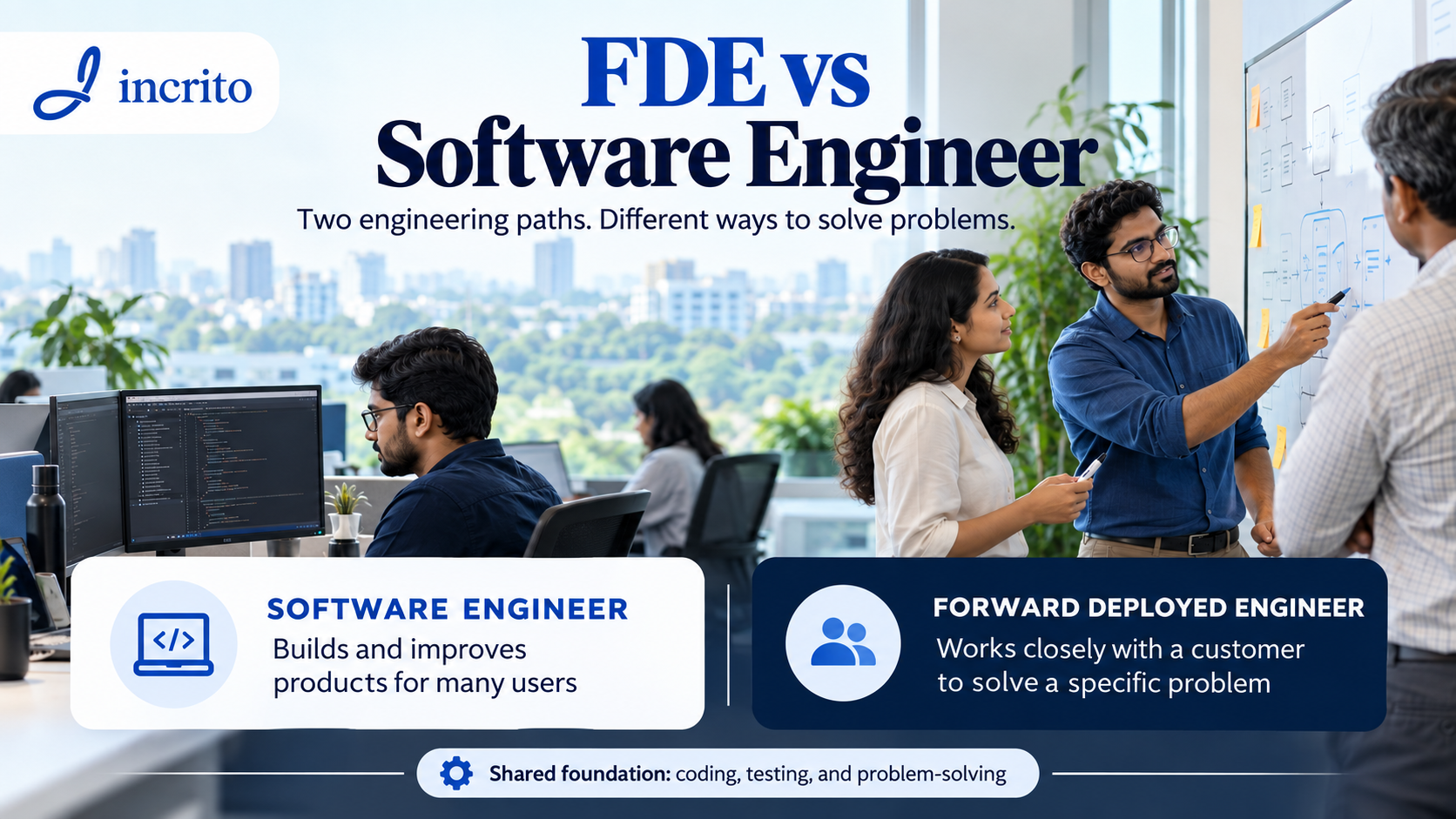
Compare Forward Deployed Engineer and Software Engineer roles, including daily work, skills, customer interaction, and career paths.
FDE vs Software Engineer: What’s the Difference?
A job listing asks for a Forward Deployed Engineer. You read the responsibilities and think: Isn’t this just a software engineer who talks to customers?
The short answer is that a Forward Deployed Engineer (FDE) is a software engineer. The difference is usually where the engineer’s attention goes. A product software engineer often builds features for a wider group of users. An FDE typically works closely with a particular customer or team, adapting technology to solve a problem in their environment.
Both roles require strong coding skills. The way they discover problems, work with users, and deliver solutions can feel quite different.
FDE vs Software Engineer: The Key Differences
Main focus: A software engineer typically builds and improves a product for many users. A Forward Deployed Engineer (FDE) works closely with a customer to solve a specific problem using software.
Who they work with: Software engineers may learn about users through product teams, research, and feedback. FDEs usually speak directly with the customer or team using the solution.
How requirements are defined: A software engineer’s work may begin with a product plan. An FDE often helps uncover the requirements by asking questions and studying the customer’s workflow.
Typical work: Software engineers build features, fix issues, and maintain systems. FDEs may do those things too, while also handling customer discovery, integrations, deployment, and improvements after launch.
What success looks like: For a software engineer, success might be a reliable feature that serves a broad group of users. For an FDE, it might be a working solution that makes a particular customer’s job easier.
What does a Software Engineer do?
Software engineers design, build, test, and maintain applications or systems. Depending on the job, they may work on a mobile app, a payment system, a website, or the infrastructure behind a product.
For example, a software engineer at a learning platform might build a new assessment feature that thousands of learners can use. They would need to think about performance, usability, security, and how the feature fits with the rest of the platform.
Some software engineers speak directly with customers. Others learn about user needs through product managers, research, support teams, and usage data. It depends on how the organization works.
What does a Forward Deployed Engineer do?
A Forward Deployed Engineer also builds software, but works especially close to a customer’s problem. They may help define that problem, connect existing systems, build a solution, deploy it, and improve it after people begin using it.
Imagine a company wants employees to find answers across its internal documents. The request sounds simple until you discover that the documents live in several systems, some are outdated, and different employees have different access rights.
An FDE would work with the company’s team to understand those constraints. They could then build and test a solution that fits the organization's actual workflow. The work might involve APIs, databases, an application interface, AI, or a combination of these.
An FDE does not always work from the client’s office. Customer collaboration can happen on-site, remotely, or through a hybrid arrangement.
How do the required skills compare?
The technical foundation overlaps. Both roles benefit from programming, debugging, testing, APIs, databases, version control, and sound engineering judgement.
An FDE role often places extra emphasis on three skills:
Discovering the real problem. A customer may ask for a dashboard when what they need is a better way to identify missing data. An FDE must ask questions before deciding what to build.
Explaining technical decisions. The people using or approving a solution may not write code. An FDE needs to explain what a system can do, where it may fail, and which trade-offs matter.
Working with existing systems. Customer environments rarely start from a blank page. An FDE may need to understand older tools, incomplete documentation, access rules, and data that does not fit neatly together.
These skills are useful for any software engineer. They are simply more visible in many FDE positions.
Which career path is right for you?
Consider the work you would like to do each week.
If you enjoy developing a product over time, going deep into its codebase, and improving how it serves a large group of users, a product software engineering role may suit you.
If you enjoy meeting users, investigating unfamiliar workflows, building solutions for specific organization, and seeing how your work performs in daily use, explore FDE roles.
Your choice does not have to be permanent. Software engineering experience can provide a strong foundation for forward deployed work. Likewise, experience solving customer problems can strengthen your judgement in a product engineering role.
Can a fresher become a Forward Deployed Engineer?
You can start preparing as a fresher, but check individual job requirements. Some FDE positions expect engineers who have already built and deployed software in professional settings.
A practical route is to build strong software fundamentals first. Create projects that solve a clear problem, ask real users to test them, and document what you changed based on their feedback. Early roles in software development, full stack development, implementation, or applied AI can also provide relevant experience.
How to start building FDE skills
Choose one problem for a real user or small team. Speak with them before you write code. Build a simple working solution, let them try it, and improve the parts that cause difficulty.
When you add the project to your portfolio, describe more than the technology you used. Explain what the user needed, what you built, how you tested it, and what you learned. That shows the thinking behind your engineering work.
Whether you pursue FDE or a broader software engineering role, the strongest starting point is the same: learn to build reliable software that helps someone do something better.
Explore your next step with INCRITO: Discover our AI and software development programs, or speak with our team about the skills you want to build.
Start with a free demo
Ready to start a career in tech?
Sit in on a free live demo class, meet a trainer and see the placement process before you enrol.
FAQ
Frequently asked questions
01Is a Forward Deployed Engineer a Software Engineer?
Yes. An FDE is a software engineer whose role generally involves close collaboration with a customer or operational team to build and deliver a solution for a specific problem.
02Does an FDE need AI skills?
It depends on the position. Some FDE roles focus on AI deployment, while others involve applications, data, integrations, or specialized platforms.
03What is the main difference between an FDE and a Software Engineer?
The main difference is usually the focus of the work. Product software engineers often build for a wider user base; FDEs typically work more directly with a particular customer and their systems.
04Can a Software Engineer move into an FDE role?
Yes. Programming and system design skills transfer well. Experience speaking with users, defining unclear requirements, and deploying solutions will help with the transition.
05Which role is better for freshers?
Neither title alone tells you whether a role is suitable. Read the experience requirements and day-to-day responsibilities. For many freshers, an entry-level software engineering role is a practical place to develop the skills needed for future FDE opportunities.
Written by
Incrito Admin